
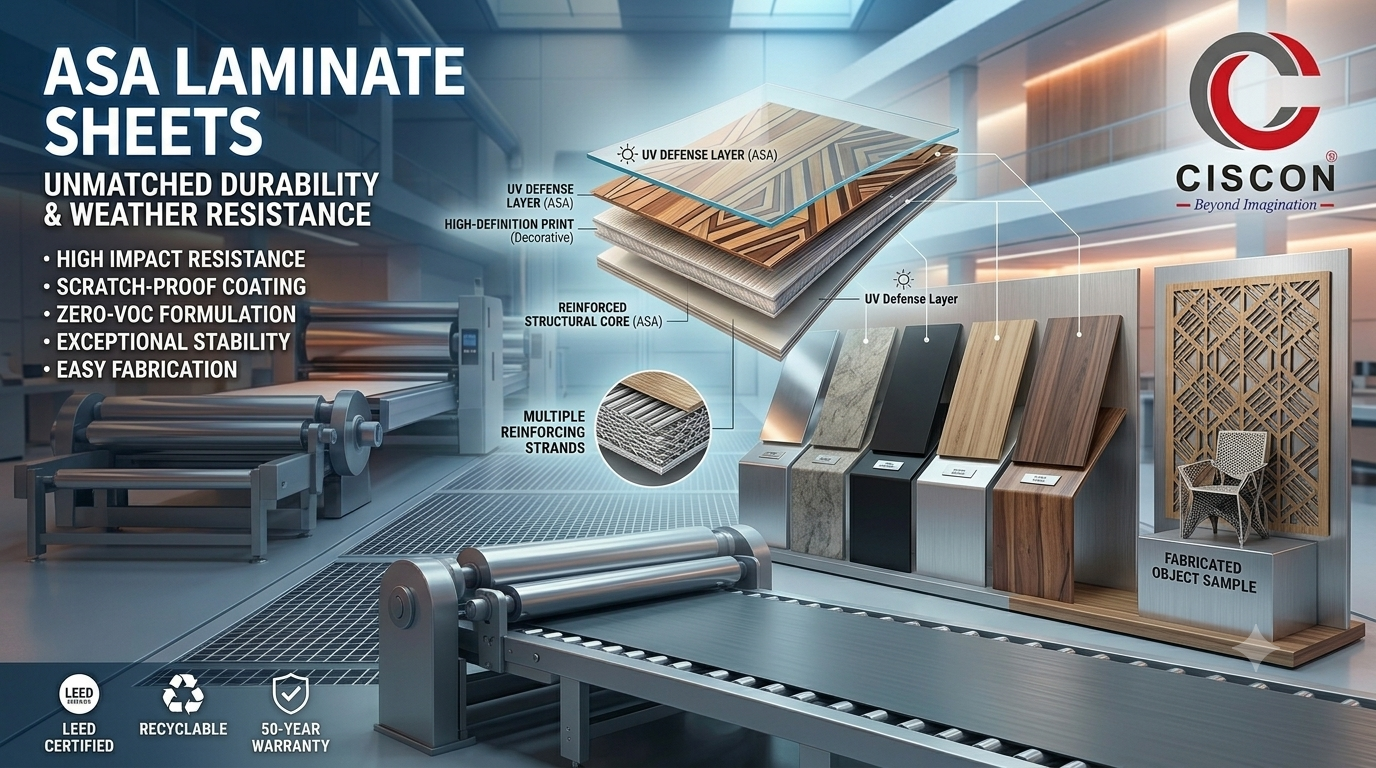
What Are ASA Laminate Sheets ? A Complete Guide to Uses, Benefits & Buying
Choosing the right exterior-grade laminate sheet can feel more complicated than it should be. Between ASA, acrylic, PVC, and HPL, the terminology alone stops many buyers before they even get to comparing suppliers. We put together this guide to cut through that confusion — what ASA laminate sheets actually are, where they perform well, and what to check before you commit to a supplier.
What Is an ASA Laminate Sheet ?
ASA stands for Acrylonitrile Styrene Acrylate, a thermoplastic polymer valued for its resistance to UV exposure, weathering, and impact compared to standard styrene-based plastics. As a laminate sheet, ASA is typically bonded or co-extruded onto a substrate to create a decorative, protective outer surface used in exterior cladding, signage, and weather-exposed architectural panels.
The material's main appeal is straightforward: it holds color and gloss under sustained sun exposure better than many general-purpose plastics, which is why it shows up repeatedly in outdoor-facing product categories — from automotive trim to building facades.
How ASA Laminate Sheets Differ From Acrylic, PVC & HPL ?
Buyers often use these terms interchangeably, which leads to mismatched expectations. Here's a practical comparison :
| Material | Typical Strength | Best Suited For | Watch-Out |
|---|---|---|---|
| ASA Laminate | High UV/weather resistance, good impact resistance. | Exterior cladding, signage, outdoor panels. | Cost is usually higher than plain PVC. |
| Acrylic Laminate | High gloss, excellent clarity and rich color depth. | Interior decorative panels, signage faces. | Less weather-durable than ASA unless UV-stabilized. |
| PVC Laminate | Cost-effective and moisture-resistant. | Interior wet areas and budget cladding. | Can degrade faster under intense UV without stabilizers. |
| HPL (High Pressure Laminate) | Very durable surface with excellent scratch resistance. | High-traffic interior surfaces and furniture. | Heavier and less flexible for curved applications. |
If your project sits outdoors year-round — a facade, an exterior signage board, a balcony panel — the UV and weathering performance of the laminate matters more than the upfront price difference. Interior decorative work has more flexibility to prioritize finish and cost.
Why UV Resistance and Weatherproofing Matter for Exterior Laminates ?
A laminate sheet's UV and weather resistance determines how it looks in year three, not year one. Poorly stabilized laminates can chalk, fade, or become brittle within a couple of monsoon-and-summer cycles, especially in high-UV climates. Weatherproofing isn't just about rain — it covers thermal cycling, humidity, and sustained solar exposure over years, not weeks.
This is where sourcing decisions matter. A supplier who can explain their UV-stabilization approach and point to consistent quality control — rather than just asserting "weatherproof" on a spec sheet — is generally a safer bet for exterior work.
Common Applications for ASA and Exterior-Grade Laminate Sheets
- Building facades and cladding - panels exposed to direct sun and rain for years
- Outdoor signage and hoardings - where color retention affects brand visibility
- Balconies and terrace paneling - combining decorative finish with weather resistance
- Automotive and outdoor fixtures - trim and housings needing impact resistance
- Decorative wall panels near windows or semi-outdoor spaces - where UV exposure is partial but ongoing
How to Choose the Right Laminate Sheet for Your Project ?
The best way to choose a laminate sheet is to match the material's weather rating and finish to your exposure conditions, not just your budget. Start with how much direct sun and moisture the surface will face, then narrow your material choice, then compare suppliers on quality consistency.
- Assess exposure level. Fully outdoor, semi-covered, or strictly interior — this alone eliminates several options.
- Decide on finish. Gloss, matte, textured, or mirror — driven by design intent as much as performance.
- Check thickness and substrate compatibility. Confirm the sheet works with your mounting system (mechanical fixing, adhesive bonding, etc.).
- Ask about UV stabilization specifics. Vague reassurance isn't the same as a documented process.
- Request samples before bulk ordering. Color and gloss can look different at scale and under real sunlight versus a swatch.
- Confirm lead times and minimum order quantities. Especially relevant for wholesale or project-scale orders.
Common Mistakes Buyers Make
- Assuming "laminate" means one uniform product. Acrylic, PVC, ASA, and HPL laminates behave very differently outdoors.
- Choosing purely on price for exterior applications. Cheaper, poorly stabilized sheets often cost more in replacement and labor within a few years.
- Skipping sample testing. A swatch under office lighting doesn't tell you how a finish will read in direct sun.
- Ignoring installation guidance. Even a good material can underperform with the wrong fixing method or thermal expansion allowance.
- Not asking suppliers about their quality control process. "UV-resistant" should come with an explanation, not just a label.
Gloss, Matte & Decorative Finish Options
Laminate sheets, ASA included, are available in a range of decorative finishes — high gloss, matte, textured, mirror, and metallic effects. Gloss finishes tend to show scratches and dust more visibly but read as premium and vivid; matte finishes are more forgiving in high-traffic or high-touch areas. For exterior decorative applications, it's worth asking whether the gloss level is expected to shift over time with UV exposure, since some finishes dull faster than others.
What to Ask a Supplier Before You Order ?
- What UV-stabilization method is used, and is it documented or tested ?
- What's the typical lifespan under [your region's] sun and weather conditions ?
- Are samples available before a bulk order ?
- What thickness and sheet-size options exist for my project scale ?
- What's the process for quality control during manufacturing or sourcing ?
- What is the supplier's track record — how long have they operated in this category ?
We've been sourcing and supplying decorative and functional laminate products — including UV-resistant sheet options — for over three decades, and questions like these are exactly what we'd expect a serious buyer to ask before committing to any exterior-grade material, ASA or otherwise.
Industry Best Practices for Installation & Maintenance
Proper installation preserves whatever performance advantage the material itself offers. Best practice generally includes :
- Allowing for thermal expansion gaps per manufacturer guidance, since plastic laminates expand and contract more than masonry or metal
- Using fixing methods (mechanical fasteners vs. adhesive) appropriate to the panel size and exposure
- Cleaning with non-abrasive methods to avoid dulling gloss finishes prematurely
- Periodic inspection of edges and joints, which are typically the first points of weather-related wear
For broader context on weathering performance standards used across the plastics industry, ASTM International publishes recognized testing methods for UV and weathering resistance that reputable manufacturers often reference.
Conclusion
ASA laminate sheets earn their reputation in exterior and weather-exposed applications because of how they hold up to UV and weathering compared to less-stabilized alternatives — but the material name alone doesn't guarantee performance. The supplier's quality process, the documentation behind UV claims, and a proper sample-and-install process matter just as much as the polymer itself.
If you're evaluating laminate sheet options — ASA or otherwise — for an exterior, decorative, or interior project, we're happy to walk through what we can offer. With over three decades in decorative and functional laminates and mosaics, we can help you think through material, finish, and supplier questions before you commit.
Call us at +91 8767776616 or explore our acrylic laminate range and UV-resistant marble sheet options to see what's currently available.
Frequently Asked Questions
ASA stands for Acrylonitrile Styrene Acrylate, a thermoplastic known for UV and weather resistance, often used as an exterior-grade laminate or coating layer.
Yes — ASA is specifically valued for outdoor and exterior applications because of its resistance to UV degradation and weathering compared to many standard plastics.
ASA generally offers stronger UV and impact resistance for sustained outdoor exposure, while standard acrylic laminate is often chosen for interior decorative work where UV exposure is limited.
All laminates can fade eventually under prolonged UV exposure, but ASA's stabilizers are designed to slow color and gloss loss significantly compared to non-stabilized plastics.
Thickness varies by manufacturer and application — cladding and structural uses typically require thicker sheets than purely decorative interior panels. Confirm exact specs directly with your supplier.
Pricing varies by supplier, region, and order volume; as a general pattern, UV-stabilized exterior-grade laminates tend to cost more upfront than basic PVC but can offer lower long-term replacement costs.
Yes, though for purely interior applications with no UV exposure, buyers sometimes choose acrylic or other decorative laminates instead, since ASA's weather-resistance advantage matters less indoors.
Lifespan depends on climate, installation quality, and the specific formulation — buyers should ask suppliers directly about expected performance under local conditions rather than relying on generic claims.
Gloss finishes offer a more vivid, reflective look but show scratches and dust more readily; matte finishes are more forgiving in high-touch or high-traffic settings.
Installation should account for thermal expansion and use fixing methods suited to panel size and exposure — mechanical fixing and adhesive bonding are both used depending on the application.